Working on a multi-artist animation project has significantly changed how I understand the importance of decision-making in early stages of animation production, particularly with how strongly rough animation determines the overall success of a sequence, and how difficult it is to correct structural issues once a production moves into later stages. While clean-up helps refining the work, it cannot fundamentally resolve problems rooted in unclear posing, timing or construction.
During the production of this film, I have also found myself really enjoying the key animation stage, focusing on posing, timing, and performance decisions rather than fully resolving every intermediate drawing in a linear process. This aligns with understanding alternative productions workflows, particularly those seen in Japanese and Easter animation pipelines, where efficiency is often prioritised due to lower production budgets compared to large-scale Western studio systems. In these workflows, key animators typically focus on strong key poses and breakdowns, while clean-up artists are responsible for refining drawings and often inbetweening as well.
This perspective also influenced my own working methods, I have noticed that I often streamline parts of the rough and tie-down process, prioritising essential key poses and allowing some in-between areas to remain less resolved at the earliest stage. This is partly driven by efficiency, particularly when working on a longer-form project such as a four-minute film, where fully resolving every drawing at rough stage can become unsustainable. However, transitioning the project into a multi-artist workflow introduced additional challenges that forced me to reconsider how I approached clarity within rough animation. While these shortcuts may function effectively in a solo workflow, relying on my own familiarity with the drawings and resolve ambiguity later during clean-up, this becomes far more difficult when other artists are required to interpret the material independently. As a result, my roughs and tie-downs needed to communicate structure, volume, movement, and acting intentions as clearly as possible to minimise guesswork for clean-up artists. This created a balance between maintaining efficiency while still ensuring that the drawings remained readable and functional within a collaborative production pipeline.
A key breakthrough in resolving this issue came from improving my understanding of spacing and construction tools within animation software, particularly with TVPaint’s off-peg functionality alongside point-to-point animation techniques significantly improved both the speed and clarity of my workflow. Working off pegs allowed me to test paths of movement much more efficiently, especially in frames where frames are very spaced out from each other, allowing me to construct movement with more fluidity and establish clearer arcs. This made it possible to create roughs and tiedowns that were substantially clearer and easier for clean-up artists to interpret, while still maintaining a relatively fast production pace. As a result, revisions were reduced considerably compared to earlier stages. This approach was reinforced through studying professional animation breakdowns, particularly the “Walks” tutorial by James Baxter (Baxter, 2026), as well as Toniko Pantoja’s explanation of point-to-point animation workflows, which helped retain consistency and construction within in-betweens using timing charts and halves, as well as rapidly flipping through the frames in order to notice invisible arcs between two keyframes, placing dots between specific accents of the character and connecting them like those paper activities where you connect the lines to make the picture.
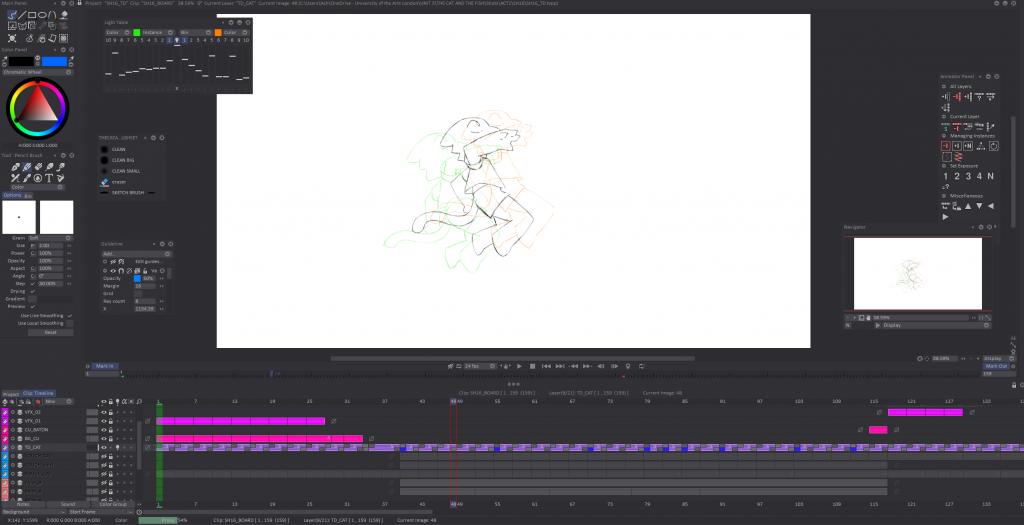
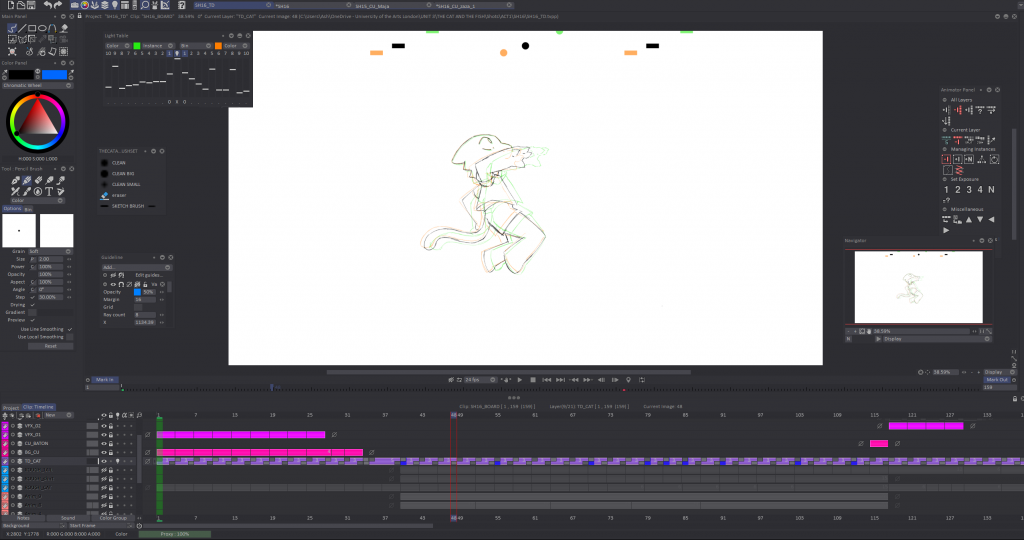
Alongside this, I also drew insight from observing professional production workflows, including livestreamed development material from Aaron Blaise’s independent short film Snow Bear, which demonstrates the iterative nature of animation production and the importance of clarity in early design and movement decisions, as well as the nature of his traditional animation workflow taken into TVPaint (Blaise, 2022).
Overall, this experience has reinforced the importance of understanding animation as a flexible pipeline rather than a linear drawing process. Efficiency, clarity, and structural decision-making at the key stage have a direct impact on the ease of clean-up and inbetweening later in production. It has also helped clarify my own working preferences within that pipeline, particularly in relation to key animation and performance-focused drawing, while highlighting the importance of adaptability depending on the needs of a production.
References
Baxter, J. (2026) Walks. YouTube. Available at: https://youtu.be/vihIPBrP6y0?si=iaUs638Fkyo0gAV3 (Accessed: 23 May 2026).
Blaise, A. (2022) Live: Working on my Animated Short in TVPaint. YouTube. Available at: https://www.youtube.com/live/LGmrz6hnzWI (Accessed: 23 May 2026).
Pantoja, T. (2016) SBW – Inbetweening and Timing Charts Demo. YouTube. Available at: https://youtu.be/0rp3zXBEhCE?si=Wy9Gu7BqbhaC6o0s&t=1353 (Accessed: 23 May 2026).
Leave a Reply